
ALL RUNNING TOURS IN COLOGNE |
|---|
SIGHTSEEING RUNNING TOURS IN COLOGNE

“JUST RUN” RUNNING TOURS IN COLOGNE

CORPORATE TOURS IN COLOGNE

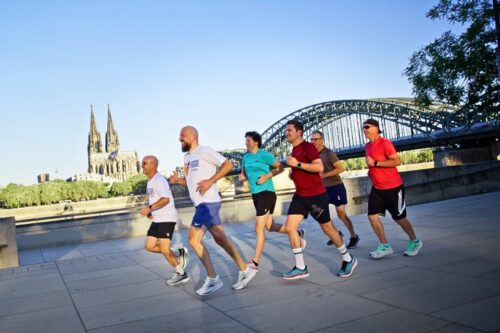
Cologne, Köln in German, is one of those cities that rewards the runner. Flat, compact, laced with riverside paths, and dense with history at every corner, it is built for exploring on foot at pace.
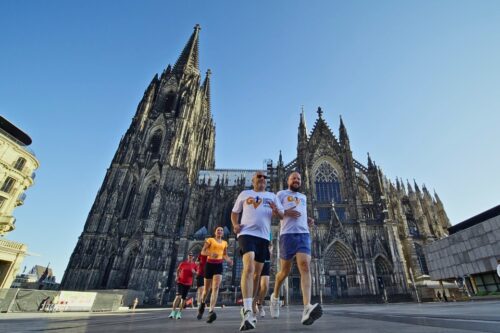
The city was founded as a Roman military camp around 38 BC and grew within a century into Colonia Claudia Ara Agrippinensium, one of the great cities of the Roman Empire north of the Alps. Traces of that world are still there to run past: intact watchtowers, buried fortresses, and a cathedral, the Kölner Dom, whose construction stalled for over 300 years and gave rise to a local legend involving a rather impatient devil.
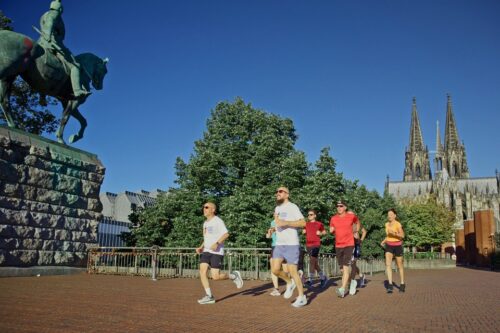
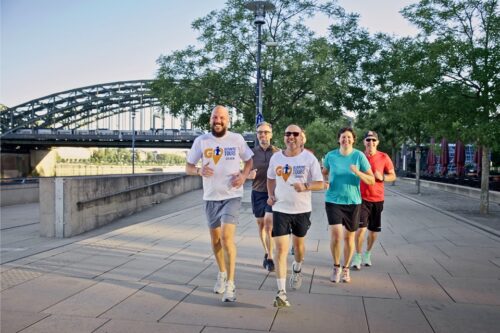
Cologne’s Rhine bridges are landmarks in their own right, from the love-lock-covered Hohenzollernbrücke to the elegant curve of the Severinsbrücke, and crossing them is one of the small pleasures of running here: the city looks different from each bank, and better from a bridge at sunrise than from almost anywhere else.
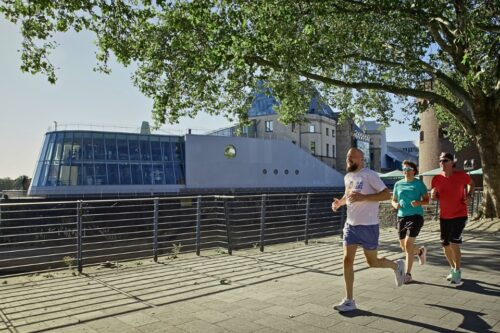
Beyond the river, Cologne holds a second landscape most visitors never see: the Grüngürtel, a ring of parks, forests and lakes built in the 1920s on the exact footprint of the city’s old fortifications. It’s where Cologne’s own runners train, and it turns out the city is just as compelling without a single cathedral in sight.
And then there are the stories. Cologne doesn’t just have history, it has gossip: a fountain telling of gnomes who did the citizens’ work by night until a curious tailor’s wife ruined it for everyone, a bronze statue that has been mooning the town hall for generations, and a puppet-theatre duo so beloved they have their own statue in the Altstadt. None of it is strictly necessary to know. All of it makes the city better to run through.
Running in Cologne is something best done in the early morning, along the river, through the parks, or past a legend or two, with enough curiosity and enough time to stop, take a photo, and hear the story. The city has been here for two thousand years. It isn’t going anywhere. Neither, it turns out, is its sense of humour about itself.